Chris Handran
Wreckers Artspace
26-27 October 2024
Obscura References
For Plato, projected light and shadow provided a perfect metaphor for the illusory nature of the material world when compared to the world of ideas.[1]
For Marx, the illusory effects of the camera obscura also provided an important metaphor, although here it is the inverted image that reflects the inversion of values caused by ideology.[2]
For Ibn AI-Haytham, the operations of the camera obscura mirrored those of the eye.[3] By conceiving of the eye as a camera that received light rays, this model refuted earlier Euclidean theories that positioned the eye as a source of ‘luminous rays’.
For Descartes, the camera obscura provided a model not for vision, but for the separation between mind and body. He conceived of human consciousness as a thinking thing (res cogitans), sitting inside a space separate from the extended things (res extensa) of the world, watching them go by.[4]
For Locke, the projections of the camera obscura afforded a different way of thinking about human consciousness. In this, the ‘empty cabinet’ with its blank projection surface was key, offering a tabula rasa devoid of content awaiting the projection of sensation.[5]
For Freud, the sensitive surface of the photographic negative played a similar role – although it was not its blankness, but the receptive nature of this surface, analogised as a ‘mystic writing pad,’ that represented the unconscious.[6]
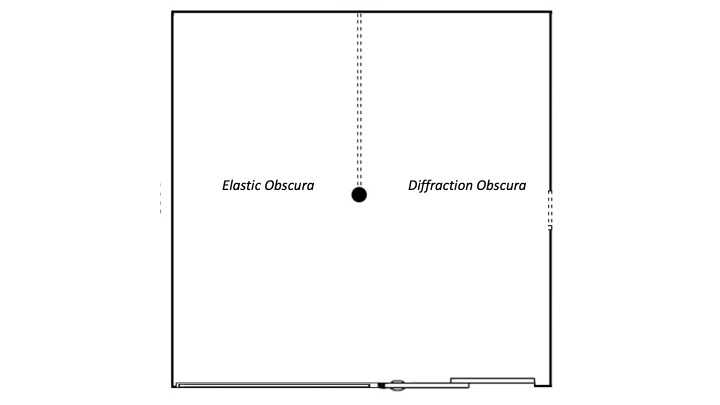
For me, many of these interpretations of the camera obscura respond to a diagrammatic representation of its operations, not to the embodied experience that it offers. Rather than a Cartesian consciousness separate from the world, for me the camera obscura reflects the entanglement of spectator, apparatus and world: the room is in the world and the world is in the room. The apparatus transforms the world into an image, but your perception also transforms that image, as your eyes adjust and you move about, becoming part of the image. For me, the camera obscura is an opportunity to engage in the performative action of light and perception. Such engagements informed the works of scientists such as Isaac Newton and Thomas Young, who intervened in the workings of the camera obscura by introducing prisms and slits to explore the operations of light. From one perspective, these actions destabilised and transform the camera obscura. From another, they foreground the way that such techniques and technologies of representation and perception are always already engaged in processes of performative action and transformation.
[1] Plato. The Republic. Translated by Desmond Lee, London: Penguin, 2007.
[2] Karl Marx and Friedrich Engels, The German Ideology (parts I and III). Translated and edited by R. Pascal, New York: International Publishers, 1947
[3] Al-Haytham, Ibn. The Optics of Ibn al-Haytham, Books I-II-III: On Direct Vision. Edited by A. Sabra, Kuwait: National Council for Culture, Arts and Letters, 1983. The analogy of camera obscura and eye was later repeated by thinkers including Roger Bacon and Leonardo Da Vinci..
[4] Descartes, Rene. Discourse on Method and the Meditations. London: Penguin, 1998.
[5] Locke. John. Essay on Human Understanding. New York: Dutton, 1976.
[6] Freud, Sigmund. The Standard Edition of the Complete Psychological Works of Sigmund Freud, edited by J. Strachey London: Hogarth, 1974.
 Christopher Handran